Expressvpn Glossary
Adaptive authentication

What is adaptive authentication?
Adaptive authentication is a security method that adjusts identity verification requirements based on assessed risk. It evaluates contextual factors, such as location, device, and behavior patterns, and applies stronger verification steps only when an access attempt appears unusual. This allows low-risk logins to proceed with minimal friction while maintaining stronger protection against unauthorized access.
How does adaptive authentication work?
Adaptive authentication evaluates each access attempt in context by analyzing signals such as IP address, device information, and geolocation, using factors such as prior sign-in patterns, device state, and other risk indicators to assess whether the attempt appears normal or suspicious. Based on this assessment, the system determines a risk level for the attempt.
If the attempt matches normal patterns, access is granted with minimal friction. If anomalies are detected, the system may require additional verification steps, such as multi-factor authentication (MFA), or in higher-risk cases, block access entirely. Many implementations refine their risk models over time by incorporating new data, improving detection accuracy.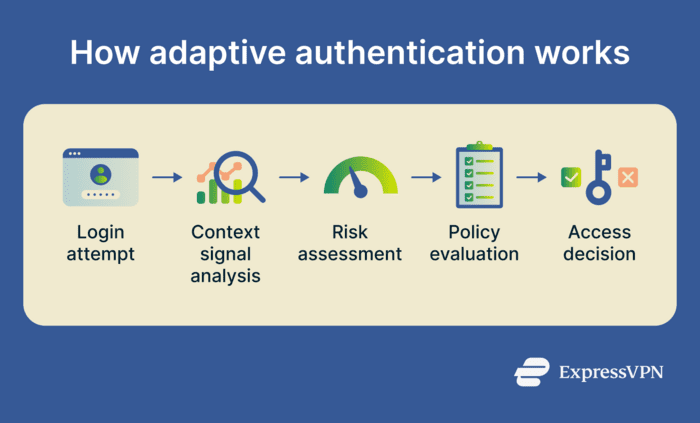
Why is adaptive authentication important?
- Reduces account takeover risk: Access decisions dynamically adjust based on contextual signals, such as device, location, and behavioral patterns.
- Strengthens identity-based security: Authentication relies on multiple contextual signals rather than only static credentials.
- Lowers friction for low-risk access attempts: Logins that appear consistent with normal activity can proceed with minimal additional verification.
- Helps identify suspicious logins: Unusual access patterns can be flagged using behavioral and environmental signals.
- Balances security and usability: Security requirements adapt to the assessed risk level of each login attempt.
Where is adaptive authentication used?
Adaptive authentication is used in environments where organizations need security that adjusts to risk during sign-in or access requests. Enterprise identity and access management (IAM) systems can enforce stronger verification when users access sensitive resources or when a sign-in appears risky.
Banking and financial platforms rely on it to protect high-risk transactions and account activity, operating under strict regulatory requirements such as the Payment Card Industry Data Security Standard (PCI-DSS), which mandates robust, risk-based authentication controls for cardholder data environments.
It is also widely used in cloud apps and Software-as-a-Service (SaaS) tools, remote workforce access systems, and customer login portals, where context-aware checks can help secure access from unfamiliar locations or devices, or other unusual sign-in conditions.
Risks and limitations
- Relies on extensive user data: Adaptive authentication often relies on collecting contextual data, such as location, time, device details, and usage patterns, to assess risk.
- Privacy concerns around behavior tracking: Monitoring sign-in and usage signals can raise concerns about data collection, retention, and the storage or sharing of behavioral data.
- False positives can block users: Legitimate users may be incorrectly flagged as suspicious, especially when no clear remediation or fallback verification methods are available.
- Weak policies create security gaps: Undefined thresholds, inconsistent rules, or poorly tuned risk signals can reduce effectiveness and leave exploitable security weaknesses.
- Poor signal quality reduces accuracy: Hardware limitations, noisy datasets, or inconsistent behavioral signals can degrade detection accuracy and increase both false positives and false negatives.
Further reading:
- Authentication vs. authorization: What’s the difference?
- 2FA vs MFA: Key differences and how to choose the right one
- Zero-trust architecture: What it is, how it works, and why it matters
- What is federated identity? A complete guide
- What is access control? How it works and why it matters